English is the official language of Belize, but Spanish, Belizean Creole, Garifuna and several Mayan languages are commonly heard—use English in most tourist settings and lean on Creole or Spanish for friendlier, local exchanges.
| Where / When | Language to use | Quick tip |
|---|---|---|
| Tourist hubs, hotels, tours, and flights | English (plus polite Creole phrases) | Start in English; use simple Creole greetings to connect locally. |
Which Languages You'll Hear — And Where To Use Each
Belize is multilingual. Below is a compact reference to help you choose the right language by place and purpose; see our deeper background on Belize’s linguistic history for context.
Read the language history and biodiversity overview →
| Language | Where you’ll hear it | When to use it |
|---|---|---|
| English (official) | Hotels, tours, government offices, menus | Default for service interactions and safety; speak English confidently. |
| Belizean Creole (Kriol) | Urban areas, markets, islands | Use casual greetings and thanks to build rapport. |
| Spanish | Border areas, southern districts, many vendors | Useful if traveling off the beaten path or in Toledo/Corozal. |
| Garifuna | Hopkins, southern coast, Garifuna communities | Use for cultural experiences; a few phrases go a long way. |
| Mayan languages | Rural Cayo and southern communities | Respectful gestures and a translator are recommended in remote villages. |
Traveler Phrase Cheat-Sheet (25 Must-Know Lines)
Use these by category. Pronunciation hints are simplified to keep them practical—say them slowly and smile.
- Hi / Hello — Hi / Hello (same)
- Good morning — Mornin’ (MOR-ning)
- Thank you — Tanks (TANKS) / Thank you
- Please — Please (PLEEZ)
- You’re welcome — N/A or ‘No problem’ (NO PROB-ləm)
- Where is X? — Where is ___? (WHERE iz ___?)
- How much? (taxi / water taxi) — How much? (HOW much?)
- Left / Right — Left / Right
- Stop here — Stop here (STOP heer)
- Water taxi — Water taxi (WAW-ter TAK-see)
- I would like… — I would like (I wood like)
- Menu, please — Menu please
- Is this spicy? — Is this spicy? (IS this SPY-see?)
- Bill / Check — Bill please
- Cash or card? — Cash or card? (CASH or CARD?)
- Help! — Help! (HELP)
- Doctor — Doctor (DOC-tor)
- Pharmacy — Pharmacy (FAR-muh-see)
- I need water — I need water
- Where is the restroom? — Where is the restroom?
Cultural Tips That Keep Conversations Smooth
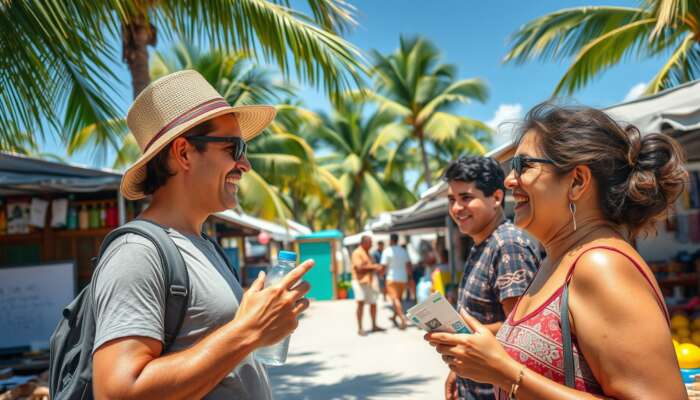
- Start in English in tourist settings; add a Creole greeting (“Mawnin'” or “Hiya”) to warm interactions.
- In Garifuna areas (Hopkins), learn 2–3 Garifuna phrases—locals appreciate any effort.
- When visiting Mayan villages, be patient, ask before photographing, and use a guide for translation.
Timing & Booking: When Language Matters
High season (Nov–Apr) brings more English-speaking staff at hotels and tours; the wet season (May–Oct) lowers crowds but increases the chance you’ll encounter Spanish or Maya speakers in quieter districts. Check month-by-month weather and planning tips before booking.
Practical Travel Notes & Next Steps
- Carry small change for markets; some rural vendors don’t accept cards.
- If you plan to island-hop, water taxis and short flights use English for announcements.
- Bring a pocket phrase list or screenshot this page—signal-weak areas are common outside towns.
Book flights and lock in hotels early for the dry season; links below help you compare options.
Frequently Asked Questions
What Are The Top 3 Languages Spoken In Belize?
English (official), Belizean Creole, and Spanish are the most common; Garifuna and Mayan languages are widely spoken in specific communities.
Do I Need To Speak Spanish To Visit?
No—English works in tourist areas, but basic Spanish helps in border regions and small towns.
How Do I Say "Hi" In Belizean Creole?
“Hi” or “Hey” works; for a local touch say “Mawnin’” (MAW-nin) for morning greetings.
Where Can I Learn More About Language And Culture In Belize?
Start with our language history overview and follow island or town guides for community-specific tips: Language history & biodiversity.

Benjamin Turner is a passionate travel writer specializing in exploring the beauty and diversity of Belize. With a keen eye for detail and a knack for storytelling, he provides readers with insightful guides that encompass everything from the country’s stunning landscapes to its rich cultural heritage. Drawing on his extensive travels throughout Belize, Benjamin aims to inspire fellow adventurers and facilitate immersive experiences for all who seek to discover this tropical paradise.

You’ve made a compelling case for why XamanekBelize stands out, but I’m curious—how does one choose between a relaxing beach day and an adventurous cave exploration? It feels like it’s a classic “do I want to sip a rum punch or zip-line through the jungle?” dilemma! Personally, I once tried to do both in one day, and let’s just say it ended with me covered in sand and more bruises than I’d like to admit.
Your analysis of why XamanekBelize stands out as a premier travel guide for Belize certainly resonates with those of us who value comprehensive information before undertaking our adventures. It’s crucial, as you highlighted, to align our travel choices with our personal interests while also considering factors like timing and local customs.
I appreciate how you’ve highlighted the importance of making informed decisions when planning a trip to Belize. Your emphasis on aligning choices with one’s route, timings, and constraints is a valuable reminder that travel isn’t just about the destination but also about the journey we take to get there. It’s fascinating to consider how a well-planned itinerary can lead to a richer experience, giving us the opportunity to immerse ourselves in the local culture, engage in adventure activities, and appreciate the breathtaking landscapes that make Belize so special.
I really appreciate how XamanekBelize emphasizes not just the travel logistics but also the cultural richness of Belize. When I visited last year, I was blown away by the local gastronomy, especially how each dish tells a story of the diverse cultures within Belize. It’s refreshing to see a travel guide that prioritizes supporting local businesses – that connection enriches the travel experience for everyone involved.
Your insights on XamanekBelize resonate deeply with me! The emphasis on understanding local culture and the need for well-informed planning aligns beautifully with the essence of meaningful travel. I recall my own journey through Belize, where immersing myself in the vibrant local customs—like participating in a Garifuna drumming workshop—was a highlight.
I find your insights on XamanekBelize incredibly compelling, particularly in the context of how vital thorough research and planning are for an enriching travel experience. It’s intriguing to think about how cultural insights can transform a trip from just a vacation into an immersive journey. For instance, when I visited Belize a couple of years ago, I spent time in local villages and learned about traditional Garifuna music and dance. That experience not only enriched my trip but deepened my appreciation for the local culture.
It’s interesting to see how XamanekBelize positions itself as a comprehensive guide to not only the stunning landscapes but also the cultural nuances of Belize. This focus on understanding the local culture is crucial in an age where travel often leans towards superficial experiences. I’ve noticed that many travel guides can gloss over the deeper aspects of a destination, and genuine engagement with local customs enhances the travel experience significantly.
It’s fascinating how travel guides, like XamanekBelize, play such a pivotal role in shaping our experiences. The emphasis on cultural insights resonates with me, as understanding the local customs can truly enrich our adventures. For instance, I remember visiting a small village in Belize where learning a few phrases in Spanish opened up amazing conversations with the locals. It transformed a simple visit into a memorable cultural exchange.
Your insights into why XamanekBelize stands out as the premier travel guide for Belize truly resonate with anyone looking to immerse themselves in the region’s rich offerings. The emphasis on tailored travel packages and support for local businesses is particularly noteworthy. In a world that increasingly values sustainable and responsible travel, it’s refreshing to see a platform that not only informs but also invests in the community.
I really appreciate how XamanekBelize highlights the importance of understanding the local culture and activities before planning a trip. It reminds me of my own experience visiting Belize a couple of years back. I discovered that chatting with locals not only helped me find hidden gems but also deepened my appreciation for their way of life. It’s fascinating how travel guides can serve as a bridge to that understanding.
Your experience in Belize really resonates with me. There’s something special about engaging with locals that enriches the whole travel experience. It’s funny how often we stick to the traditional tourist spots, missing out on the true essence of a place. Speaking with those who live in the area can yield so many hidden gems, whether it’s a secluded beach or a family-run restaurant that’s been serving for generations.
Your insights into the unique aspects of Belize have truly resonated with me. I’ve always found that the blend of rich culture and breathtaking nature there creates experiences that linger long after a trip is over. The emphasis on understanding the local context—like cultural insights and activities—really enhances the journey.
It’s fascinating to see how Belize’s linguistic diversity reflects its rich cultural tapestry. The fact that English is the official language while so many other languages thrive in various communities speaks volumes about the country’s history and the interplay of cultures. In many ways, language is not just a means of communication; it’s a gateway into the heart of a community and its traditions.
You bring up such an intriguing point about language as a window into culture! In Belize, the interplay is truly vibrant, with English serving as the bridge while Creole, Spanish, and various Mayan languages weave in and out of daily life. Each language opens up a different facet of community and identity.
This is such an insightful overview of Belize’s linguistic landscape! Having traveled there a couple of years ago, I can definitely vouch for the rich tapestry of languages you encounter. I remember feeling a bit like a language explorer, shifting from English in the tourist spots to trying out “Wah gwaan” in Belizean Creole when chatting with local vendors. It really seemed to break the ice and foster a genuine connection.
I found your insights on the linguistic landscape of Belize fascinating! It’s so enriching to see how language acts as a bridge connecting tourists with locals. When I visited Belize a couple of years ago, I noticed how a simple “howdy” or “wah di gwan” in Belizean Creole could spark smiles and warm conversations with local vendors—it really enhanced my experience.
It’s fascinating to explore how language shapes our experiences in culturally rich places like Belize. Your post sheds light on the rich linguistic tapestry of the country, which is such an important aspect of its identity. As someone who has traveled to various multilingual environments, I can attest to the transformative power of language in bridging connections between locals and visitors.
It’s fascinating to see how language reflects the rich cultural tapestry of Belize. The multilingual landscape you’ve described truly encapsulates the nation’s diverse heritage and its history of confluence between various cultures. I’ve always found that language is not just a means of communication but a gateway to understanding a place on a deeper level.
You really highlight an important point about how language goes beyond mere words; it’s woven deeply into the identity of a place. In Belize, the mix of languages like English, Spanish, Kriol, and various Mayan and Garifuna languages illustrates not just communication but also a history of interactions and exchanges.
“Thank you for your insightful comment! If you’re interested in exploring more about Belize’s vibrant culture and languages, check out this link for an enriching experience.”
https://xamanekbelize.com/belize-adventure-tours
Your exploration of the linguistic landscape in Belize opens a fascinating window into how language shapes not just communication, but also cultural connections. Living in a multilingual setting such as Belize showcases the diverse influences that have woven together to form its rich identity. The coexistence of English, Spanish, Belizean Creole, Garifuna, and various Mayan languages is not merely a practical matter for tourists; it reflects the country’s historical tapestry, its colonial past, and the vibrant heritage of its indigenous peoples.
It’s fascinating to see how Belize’s linguistic landscape reflects its rich cultural tapestry. The fact that English is the official language, yet so many other languages thrive, demonstrates the country’s diverse heritage. For travelers, this multilingual environment not only adds depth to the experience but also serves as a reminder of the importance of cultural sensitivity and engagement.
I found your insights on the linguistic diversity of Belize fascinating, especially considering how language operates not just as a means of communication, but also as a bridge to cultural understanding. It’s intriguing to think about how, in a place like Belize where multiple languages coexist, choosing the right one can enhance interaction and foster a deeper connection with local communities.
It’s great to hear that the linguistic diversity in Belize resonated with you. Language really does shape our interactions in such profound ways. In Belize, you find not just a mix of English, Spanish, Kriol, and various Mayan languages, but also the stories and histories these languages carry. Each choice of language during a conversation can be like opening a door to different cultural experiences.
It’s interesting to see how diverse Belize’s linguistic landscape is, especially since many visitors might not realize just how many languages are spoken there. I had a chance to visit a few years ago and found that even a simple “how are you” in Creole really opened up conversations with locals. It’s fascinating how language can break down barriers and create connections.
This is such an interesting take on the linguistic diversity of Belize! I love how language can bridge cultural gaps, especially in a tourist-friendly environment. During my last visit, I found that using a few words in Belizean Creole truly opened up warmer interactions with locals. It felt like I was part of the community, even if just for a moment.
This is such an intriguing look into Belize’s linguistic landscape! Having traveled there recently, I can attest to the richness that comes with hearing multiple languages in one place. Using English as a starting point makes it accessible for most tourists, but leaning into Belizean Creole or Spanish really opens up deeper interactions with locals.
I really love how multicultural Belize is, especially when it comes to language—it’s like a little representation of the diversity there! The idea of using simple greetings in Creole or Spanish is such a cool way to break the ice with locals. I remember when I visited a few years ago, I tried my hand at a few phrases in Spanish, and it always got a smile—people appreciate the effort, even if it’s just a “hola” or “gracias.”
I really appreciate your insights on the linguistic landscape of Belize! It’s fascinating how the country’s rich tapestry of languages not only reflects its diverse heritage but also plays a crucial role in the cultural interactions you experience there. The idea of using simple Creole phrases as a bridge to connect with locals resonates deeply with me.
It’s fascinating how Belize’s linguistic diversity reflects its rich cultural tapestry. I remember visiting a small village where locals welcomed me not just in English but also in Creole and Garifuna, which made the experience feel much more authentic. It’s incredible how language can bridge gaps and create connections, don’t you think?
Your insights on the linguistic landscape of Belize really highlight an often overlooked aspect of travel—the beauty and necessity of engaging with local cultures through language. I’ve found that speaking even a few words of the local language can significantly enhance interactions and build rapport with residents. For instance, during my last trip to Central America, I noticed how my attempts to communicate in Spanish while in Guatemala opened up conversations that would likely have remained surface-level had I only relied on English.
Your exploration of the linguistic landscape in Belize truly highlights its rich cultural tapestry. During my travels there, I found that simple greetings in Creole opened doors to deeper connections with locals, demonstrating how language can bridge gaps between visitors and residents. It’s fascinating to think about how language influences our travel experiences; speaking even a few words of a local dialect can transform interactions from merely transactional to genuinely engaging.
It’s fascinating how language can be such a gateway to deeper connections with local cultures. During my last trip to Belize, I found that even a simple “béliz” or “how yuh doin’?” in Belizean Creole opened up friendly conversations with locals. It made me realize how important language is for fostering community and understanding. I’d love to hear more about others’ experiences—did anyone try learning a few phrases in Garifuna or one of the Mayan languages? Those languages must hold so much history and cultural significance. Language truly enriches our travel experiences in a way that mere sightseeing cannot!
It’s interesting how language reflects the cultural tapestry of a place like Belize. The multilingual nature not only highlights the country’s diverse heritage but also raises questions about the role language plays in tourism and local identity. While English is the official language, it seems that using Creole or Spanish can facilitate a deeper connection with locals.
It’s fascinating how Belize’s linguistic diversity reflects its rich cultural tapestry. During my last visit, I found it really rewarding to incorporate a few Creole phrases when chatting with locals. Just a simple “How yuh doin’?” instantly changed the tone of our interactions, making them feel more personal.